Showing posts with label growing in a hoophouse. Show all posts

Saturday, December 26, 2009

Tokyo Garden Update - Winter Crops Sprouting

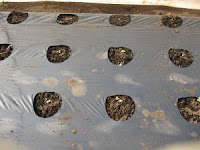
One of the best parts about today (other than speaking with friends and family back home celebrating Christmas) was peeking into the row covers and seeing little tiny sprouts looking back!

We planted just under 360 seeds on December 13th in freshly tilled soil. This time of year calls for leafy green vegetables that can withstand the chilly nights (dipping a tad bit below freezing on occasion) and short hours of sunlight. (It's dark dark about 5pm, and doesn't get light until about 7am.) I'd had a few moments of stomach-dropping doubt when I didn't see any sprouts the past few visits. And while the little guys are difficult to see in the photo at left the resulting sigh of relief and shared smile with the Takashi's as we peeked in made it well worth the wait.

Here's what we planted:
  • Pak Choi - one of the many tasty Asian greens that are perfect in stir fry or salad.

  • Komatsuna - A tasty Japanese leafy green named after Tokyo's Kamatsu River it has a nutty spicy flavor, and we can't wait to chomp into it. This article gives a fascinating history of local vegetable varieties, including Komatsuna. My garden is just off the map to the west past Mitaka.

  • Karashina - We put in two kinds of green and one kind of red. Karashina resembles mizuna somewhat in appearance, but has a zippier taste that has made it a favorite in our house salads. Like mizuna, karashina can also be added to nabe, oden, and miso for a nice touch of green.

  • Edible Chrysanthemums - I don't actually know much about these, except that they are edible. I bought some once and we added it to our salad mix, and the taste was a bit bitter but the leaf shape was nice.

  • Spinach - We planted two kinds of spinach to see what we would get. One seed was rounded, and the other seed had little spikes on it that were uncomfortably pokey even for the short time I held them in my hand.

The Takashi's recommend the use of black plastic mulch. Just like any mulch it keeps the soil warm, keeps down weeds, and retains moisture. We didn't use it over the summer, but it seemed like a good choice given the low temps and short sunlight for this time of year. All of this was topped off with perforated plastic to create a long mini hoophouse tunnel. We'll see how it all goes!

Monday, February 9, 2009

Hoophouse Growing Reflections

I recently gave a talk for Project Grow about Growing in a Hoophouse, which was great fun. There were so many interested participants who also offered so much of their own knowledge and experience that I felt I learned a whole load of new information, too. The following post is one I wrote for the Project Grow blog, but thought it would be good to add here, too.

We are working on getting the documents up from Saturday's class. (We're experiencing some technical difficulties, but they will hopefully be remedied shortly.) Drop us a note at Project Grow and we'll find a way to get you the information you want.

The Resource List offers links to various websites, recommended reading, and a short list of blogs. Suggested additions to this Resource List would be more than welcome. One great idea from an attendee on Saturday for those who don't wish to fool around with creating their own was, I believe, the Greenhouse Mega Store.

The actual presentation offers mostly pointers, guidelines, and some lessons learned. Questions on Saturday centered mostly around ventilating - how long and at what temperature; building materials - PVC or no PVC; site selection and ordinances on building such a structure.

Ventilation
Ventilating the hoophouse is pivotal. Built to help retain heat and protect plants inside from cold weather, temperatures inside can easily and quickly run high. Left unattended a little too long in the early days of having one, our temperatures reached into the low hundreds. The transition from hot to cold could prove a bit much for plants - cooking then freezing which would wilt me, I must confess - and needs to be mediated a bit. A good rule to follow would be that if interior temperatures run above 90 degrees it's time to ventilate. To keep some of that great heat it's best to close it up again an hour or so before sunset.

Some suggestions about heat included having barrels of water inside painted black. These would act as a heat sink during the day and slowly release their accumulated warmth through the night. They could also be used as a water source for plants. Others suggested building the hoophouse against another structure with a south-facing wall such as a garage, shed, or fence.

Building Materials
We used PVC pipes and translucent plastic, but not without some trepidation. As we learn more about how such plastic is not the best for us, some attendees asked about alternative materials such as electric conduit. Our neighbors at Frog Holler made theirs out of cedar milled from their land to create one of the prettiest hoophouses one could imagine. (Theirs also succumbed, unfortunately, to the snows this winter.) No structure is infallible, but it pays to research the design as well as the design materials to see what you think will work best for what you want.

Our criteria were that it be relatively easy (we're not handy people), inexpensive (the whole point of building this was to keep eating our own food as much as possible), and temporary (we wanted to switch it to other beds or take it completely out as desired.)

Site Selection and Ornery Ordinances
We built ours on existing garden beds with relatively established crops we wanted to keep growing and that were cold tolerant, i.e. kale, broccoli, parsley, beets, swiss chard, etc. The spot already received a fair amount of sun and would continue to do so over the coming chilly months. Remember the sun swings lower in the sky, so trees or buildings that might not cause a shade issue in the summer may as winter approaches.

We also live in the country so we have relative freedom to do what we like despite the opinions of our neighbors. Folks in the city may not have this luxury, and it might be a good idea to chat with your neighbor who shares the view of your backyard. (An offer of vegetables, soup or other meals might prove the winning ticket in this instance. Maybe even space to grow something!) You may also run up again rules of neighborhood associations or the city itself. As someone at the recent Local Food Summit suggested, a touch of green civil disobedience may be interesting and generate interesting conversation for these long winter months.

Monday, December 29, 2008

End of the Hoophouse and the Garden

We took the hoophouse down today. Heavy snows coupled with high winds wreaked absolute havoc. The plastic ripped in a number of places along the sides, the doors tore off the ends, and the pipe forming the ridge pole snapped leaving a jagged end flailing about the interior of the remains. The makeshift cold frame we created inside collapsed as well in the wind, rain and snow.

Miraculously, the kale from the summer carries on despite all, and even some of the little sproutings from the fall remain standing and brilliantly green. Even some of the swiss chard wags a brilliant stem and leaf in a last glimmer of fresh, homegrown goodness. We'll be happily sharing them this evening with family and friends in for the holidays.

As unsurprising as this moment is, it is still a bit sad. I had hoped to eat from our garden until the day we left for Japan, and that my neighbor would share in the bounty of it after we had left. And in some ways that will still be true. Our larder, despite overflowing gift bags to family and friends in Michigan and Wisconsin, is still quite full. The pickled beets we enjoyed last night with our soup and salad were a delight, and I confess the jar in the refrigerator is still on my mind. As a friend once told me, that pop as you open the jar is one of the most satisfying sounds. I immediately harken back to the moment they were canned - the heat, the sun, the smell of the spicy brine, and sometimes even the field where they were picked - and relish the thought of their sweet and sour taste.

We will, of course, resurrect the hoophouse and cold frame when we return from Japan. The design will be tweaked for a stronger structure, and the use of plastic will be reviewed. We have been giving some thought to an A-frame. And the cold frame, at the very least, will not have cardboard sides. Both were a joy to us and made sense in many ways for how we wish to eat and therefore live. It has been a good learning experience.

This marks, as well, the near final farewell to the garden. Whatever kale we receive now is bonus material, and our primary focus will be on redoing the paths and priming the beds for a good rest. I see truckloads of manure in my future along with landscape cloth and newspapers. That, along with whatever agrarian and vegetable adventures I have in Japan are something to look forward to in the new year.

Tuesday, December 23, 2008

More Hoophouse Blues

When it rains, it pours. Or in our case, it snows a ton.

Right on the hoophouse. Causing it to cave in.

Again.

And then temperatures drop to Arctic-like levels.

So, we've decided that the hoophouse is coming down after the holidays. It's been great, but the design is not ideal for snowy weather. It would be better if the the ridge pole along the center had supporting poles - two on either side of the center of the arch - to help keep it up during a snow. The doors need some refining as well, as do the clamps. The clamps are painful to work with, and it makes opening and closing the doors an unwelcome proposition. Under consideration for the next time around are hard sides with actual doors and actual windows at the top. The seal would be better and the overall integrity of the structure would also be improved.

On a happier note, the cold frame inside the hoophouse did well. (And it wasn't crushed in the collapsing!) This will carry on in future structures, but most likely with a more organized approach. I'd like more frames and not made out of cardboard at the last minute. There's no shame in such things, but it is still less than ideal.

Saturday, December 13, 2008

Rescuing the Swiss Chard

The Swiss Chard needed help. A little bit of frostbite turned parts of the stems brown and some of the leaves looked more than a little wilted. These now short plants still manage to push out some brilliant leaves that I gratefully harvest every so many days. But this situation could not last much longer.

We tackled the long talked of cold frame idea this past Saturday. We looked up a few different diagrams and plans, and settled on two possibilities. (There were tons more but these seemed the most helpful to us.) This cold frame description is helpful and describes what to watch out for and how a cold frame can be used. By far the simplest and most straight-forward explanation, this is the one we eventually decided to follow.

The Savvy Gardener offers a very nice description of cold frames and hot beds along with an assortment of building plans from the electric to the old window kind. I'd never heard the term hot bed before, but now I know that's what we were aiming for somewhat when we hauled in the horse manure. The site does a nice job explaining the wide variety of ways plants can be protected from the cold and how great a job each device does.

The cold frame is meant to go inside the hoophouse to add an additional layer of protection for the Swiss Chard. Eliot Coleman, author of The Four Season Harvest, inspired this idea. (His cold frames and hoophouses are near works of art, whereas ours are a bit more equivalent to cheap knock-offs of name brands. They may not last as long, but for now they get the job done.) By having a cold frame inside the hoophouse the growing season for things like swiss chard, parsley, and other semi-sensitive greens is extended in some cases right through the coldest weather.

We fashioned our cold frame from an old window a neighbor was throwing out, some old pipe insulation, and a cardboard box. We cut the cardboard to fit the window dimensions, angled the sides to drop and allow sunshine in, and used the insulation to offer a tighter seal between the window and the cardboard. We used cardboard because we were in a hurry, and we wanted a relatively safe test run before committing to wood. Plus, inside the hoophouse the cardboard won't break down very quickly at all.

We chose a spot where we could fit in the most Swiss Chard, and snuggled the frame into the dirt. I scooped in some of the horse manure to help seal the base further and offer a little additional warmth. The insulation went around the top, and the window went on top of that. Ta-dah! Cold frame in a hoophouse. Now we just need to rescue the Dinosaur kale, and the seedlings...

Thursday, December 11, 2008

Hoophouse Harvest

The plants are still small in the hoophouse, and it does get a bit chillier in there than I would like; however, it is so satisfying to still be able to go down to the garden and gather some greens for dinner.

I picked this pot full as I wasn't sure how things would fare during a cold spell and we hadn't built our cold frame yet. Since then we've also tightened and tidied the sides and I think the temperature is holding better. I whipped them up into a salad that evening; threw them raw into wild rice "casserole" with olive oil, cumin, canned tomato sauce, and a little soy sauce for the neighbors; and then sauteed the rest with olive oil and garlic for our usual favorite dinner.

Tuesday, December 2, 2008

Hoophouse Minor Catastrophe - Details

I finally went down to the hoophouse with a camera to document some of what's going on in there. The close-up of the bent pole is quite impressive in its way, and effectively illustrates why it's a good idea to get the snow off the roof as soon as you can. (You can see the roof sagging with the weight of even a small amount of snow.) I also noticed a hole in the roof from where it must have landed on something.


A positive note is that the little Russian Kales are coming up nicely and looking strong, and the corn salad is, too. I harvested a goodly handful of swiss chard, kale, and some beets, too, for dinner. We're slacking on the cold frame, but hope to get that and the roof squared away soon.

Sunday, November 30, 2008

Hoophouse Blues

I just investigated our hoophouse for the first time after our return from Wisconsin. We got a fair amount of snow while we were away, and the weight of it caused one of the "ribs" to bend and the roof to collapse. Our friends at Ambry Farms stopped by to check out our dilapidated barn, and quickly moved to remedy the situation. They propped up the bent rib with a board, but we'll have to fix things up a bit.

All seems well inside, but I can tell folks are chilly in there. I think I'm going to have to harvest the bulk of the Swiss Chard tomorrow unless we build a cold frame over it. The seedlings, strangely enough, don't seem to be suffering much. Perhaps I can't tell because they are so small, but they look good. The chives and parsely? They look like they could use a hug and a warm cup of tea - compost tea, that is!

Photos tomorrow after I clear off tonight's snow. Fingers crossed for the folks in the hoophouse.

Tuesday, November 25, 2008

Hoophouse Update - Maturing Manure

So far, so good. The smell is not overwhelming when one enters, and there is a pleasant sort of humid feel in there when you enter. The overall draftiness of it is still slightly problematic in terms of keeping the temperature high enough for the plants. They are starting to show a bit of wear and tear from the low night temperatures we've been having. I think we need another load. I'm giving serious thought to bringing in some tires, stacking them, and filling them with fresh manure. It would be an easy way to contain the manure, and still get the benefit of its decomposition.

Friday, November 21, 2008

The Power of Poop

We're hopeful it's powerful, anyway. Things are a wee bit chilly in the hoophouse these days since winter started really moving in, and a neighbor suggested manure for a bit of a heater. The relatively fresh and therefore "hot" manure will give off heat as it decomposes. It will nourish the soil (depleted by our lovely tomatoes and eggplants this summer) at the same time it helps keep our swiss chard, broccoli, kale, and parsley cozy during these long winter nights.

Since this is an experiment, I mixed some in with the soil and some I left only lightly mixed in to the soil. Some we plopped in a corner. And since it's horse manure there's plenty of straw still...well, visible...so that may help with composting/decomposition. Horse manure is not the ideal choice for your garden it should be said. Word has it that since many things (i.e. seeds and grains) simply make their way through the horse and out again that you end up with lots of extra weeds. I do battle some weeds I have seen in the horses pasture at our friends house, so I suspect there is a grain of truth in this.

A book I'm reading at the moment talks about how fresh manure gives off amonia as it decomposes, but my thought is that the hoophouse is fairly well ventilated by nature of its construction it shouldn't really be a problem. We use this practice for our chickens to help them stay warm through the cold weather. We just add a fresh layer of litter periodically to keep things fresh for the girls, and the heat given off by the composting process of their droppings and the bedding keeps them snuggly. And since the door is open all day while they roam there is no risk of anyone getting asphyxiated.

We'll see how things fare. When I went in today to get some greens and check on the plants I did notice that things looked like they were suffering a bit from the cold. Hopefully, this helps until we get the cold frame built.

Friday, November 7, 2008

Bok Choi in the House!

In the hoophouse, that is. I suspected two days ago that I saw little sprouts, but yesterday I spied a sweet little row of those first leaves - the cotyledon - that begin the process of photosynthesis. (Hope you don't have to squint too much to see them in the photo!) The unseasonably warm weather the past few days, I am sure, was quite helpful in getting things going. Things are meant to become a bit more wintry now, so we'll see how the remaining seeds do.

Tuesday, November 4, 2008

Monty the Praying Mantis

Monty, our Praying Mantis, is enjoying the hoophouse. My hope is that he's snacking on all those dastardly cabbage worms that we are currently sharing our kale and broccoli raab with. He (only my assumption that this is a male) is tricky to see due to his clever natural camouflaging. The photo at the left illustrates this fairly well, I think.

A praying mantis is a good sign for any garden as it is a natural predator for some of those nasties that you don't wish to share your harvest with, i.e. cabbage worms, aphids, tomato hornworms, etc., and saves me the gross job of picking them off and then feeding them to the chickens.

I also thought it was a good sign that I found a praying mantis egg case (see photo at left) on the bottom of one of the pallets we used for garden paths. Come spring the little ones will emerge bearing a striking resemblance to their parents, and their first meal may well be one of their siblings. Yikes.

Monday, November 3, 2008

Planting and Transplanting in the Hoophouse


Seeds of corn salad, russian kale, spinach, and two kinds of heirloom peas, along with two broccoli plants from the summer are snugly settled in the hoophouse even as I type.

Aimee and I put down pavers left over from our patio reconstruction and at her suggestion I made a straight path. This means that both beds got expanded - one in a much needed way - and that compost and composted manure got hauled in to do so.

No sign of the bok choi sprouting yet, but my fingers are still crossed.

Thursday, October 30, 2008

Balmy Hoophouse Thoughts

I ducked into the hoophouse today to check on things and warm up a bit. We're waiting on a part for our new woodstove, and so the house is chilly. A little work in there seemed like a good choice.

Once inside I found it was a balmy 65 degrees and climbing. Everything looked great although it was a bit dry. There is a fair amount of condensation on the plastic, but it isn't enough to really water the plants. I did a little watering and planted a nice little row of bok choi seeds. They should germinate, but we'll see how quickly they actually grow in these short hours of daylight. Then it was a little weeding, and plucking cabbage worms off the kale and calabrese plants. No sign of the praying mantis, but there was a lovely little ladybug wandering around.

While in many ways I had been more than ready for the garden to be done, I am so glad we have the hoophouse. Not only is it a cozy spot, but we have a ready supply of tasty greens and herbs. The beets seem to be coming along nicely, and once we finish working on the adjacent bed I'm going to put in some more kale, transplant some volunteer lettuce, and see what else I can try my hand at.

Saturday, October 25, 2008

Hoophouse Updates

We've learned a few fascinating things about hoophouses since we've constructed ours.

1. It's easier the second time around. We helped our friends Bryan and Aimee at Ambry Farms construct a hoophouse the next day, and the four of us finished up in just over an hour.

2. It works! We checked the temperature the next day in ours, and by noon it was at 106 degrees. The praying mantis and cabbage worms seemed very much at ease. Yikes!

3. Keep an eye on the structure. We found about a day or so later that one of the ribs disconnected from the ridge pole. Bryan and Aimee had the same issue, but came up with a good repair. (It happens to be the same one that the original designer came up with when he encountered the same problem.)

4. Less light gets through. I felt like a real rocket scientist when I realized that (duh!) less light was getting through to my plants. Things seemed a little wilted and not so colorful. Since the sunlight comes through the plastic now there is a fraction less of already short daylight coming to the plants. I'm still pondering this one.

5. Be careful how you seal it. Our sides are not as well sealed perhaps as they should be. We haven't lost anything to frost, but I think it might be a bit chillier than is ideal. We'll be addressing that today when we work on reinforcing the overall structure.

6. Be careful with the clamps. While making our adjustments to the hoophouse this afternoon, we (ok, it was actually me) moved one of the clamps by sliding it down. It sliced the plastic open resulting in an unwanted vent. We fixed it with tape, but we'll have to keep an eye on it the rest of the season. (And I'm not allowed to touch the clamps any longer.)

7. Plan a party! We're having a Hoophouse Hoopla this Friday. We can't really let folks in after a certain period as we'll have to close the doors for the night, but we are so excited we thought it would be a good thing to share. Any excuse for a potluck and bonfire...